
Parent Functions Chart: A Comprehensive Guide
Parent functions are foundational graphs, like linear, quadratic, and absolute value, crucial for understanding function transformations and precalculus concepts;
downloadable PDF charts aid learning.
Parent functions represent the most basic form of a function family, serving as building blocks for more complex functions. Understanding these core functions – linear (y=x), quadratic (y=x²), absolute value (y=|x|), and others – is fundamental in algebra and precalculus. A parent functions chart, often available as a PDF resource, visually organizes these functions, displaying their graphs, domains, ranges, and key characteristics.
These charts are invaluable tools for students learning to identify function types and predict how changes to the equation will affect the graph. They provide a quick reference for recognizing transformations like shifts, stretches, and reflections. Mastering parent functions streamlines the process of analyzing and manipulating functions, ultimately enhancing problem-solving skills;
What are Parent Functions?
Parent functions are the simplest versions of function families, establishing a baseline for understanding their behavior. They embody the core characteristics of each function type – linear, quadratic, absolute value, cubic, and more – without any transformations applied. A comprehensive parent functions chart, frequently found as a downloadable PDF, showcases these fundamental equations and their corresponding graphs.
These charts are essential because all other functions within a family are derived from their parent. By modifying the parent function’s equation, we create transformations. Recognizing the parent allows for quick analysis of these changes. Studying these foundational forms, as presented in a chart, builds a strong mathematical intuition.
The Importance of a Parent Functions Chart
A parent functions chart, often available as a convenient PDF download, is an invaluable tool for students and educators alike. It provides a concise visual reference for the core functions – linear, quadratic, absolute value, and others – displaying their equations, graphs, domains, and ranges in one place. This centralized resource streamlines learning and reinforces key concepts.
The chart’s utility extends beyond simple memorization; it fosters a deeper understanding of function transformations. By comparing transformed functions to their parents, students can readily identify shifts, stretches, and reflections. Accessing these charts digitally, as PDF files, allows for easy portability and integration into study materials.

Core Parent Functions and Their Properties
Core parent functions—linear, quadratic, absolute value, and square root—form the basis for understanding more complex functions; PDF charts detail their attributes.
Linear Function: y = x
The linear function, y = x, represents a straight line passing through the origin, serving as a fundamental parent function in mathematics. Its simplicity allows for easy visualization and understanding of slope-intercept form. A parent functions chart PDF will clearly illustrate this basic graph.
Understanding this function is vital for grasping transformations like shifts and stretches. The domain and range are all real numbers, extending infinitely in both directions. It’s an odd function, exhibiting symmetry about the origin. Resources, including downloadable PDF guides, emphasize its role in building a strong foundation for more advanced mathematical concepts.
Domain and Range of the Linear Function

For the linear function, y = x, the domain encompasses all real numbers, denoted as (-∞, ∞). This signifies that any real number can be input into the function. Similarly, the range also consists of all real numbers (-∞, ∞), meaning the function can produce any real number as an output.
A comprehensive parent functions chart PDF visually demonstrates this unbounded nature. Understanding the domain and range is crucial for analyzing function behavior and limitations. These concepts are foundational for more complex functions. The linear function’s unrestricted domain and range highlight its continuous and all-encompassing nature, a key element in mathematical analysis.
Graph and Key Features
The graph of the linear function, y = x, is a straight line passing through the origin (0,0). It possesses a slope of 1, indicating a 45-degree angle with the x-axis. Key features include its symmetry about the origin, classifying it as an odd function. A parent functions chart PDF clearly illustrates this simple yet fundamental graph.
The line extends infinitely in both directions, visually representing its unbounded domain and range. Its consistent slope signifies a constant rate of change. Understanding this basic graph is essential for grasping transformations and more complex linear equations. The simplicity of the line makes it a cornerstone of mathematical visualization.
Quadratic Function: y = x²
The quadratic function, y = x², is represented by a parabola – a U-shaped curve. Its vertex lies at the origin (0,0), serving as the minimum point of the graph. A comprehensive parent functions chart PDF visually demonstrates this iconic shape; The parabola exhibits symmetry across the y-axis, classifying it as an even function.
Key features include its rapid increase as you move away from the vertex, showcasing a non-linear relationship. Understanding the parabola’s shape is crucial for modeling various real-world phenomena. The graph’s curvature and symmetry are fundamental concepts in algebra and calculus, readily accessible through visual aids.
Domain and Range of the Quadratic Function
The domain of the quadratic function, y = x², encompasses all real numbers. This means you can input any value for ‘x’ and obtain a valid output. A parent functions chart PDF clearly illustrates this unrestricted input. However, the range is different; it’s all non-negative real numbers (y ≥ 0).
Because squaring any real number results in a positive value or zero, the graph never dips below the x-axis. This is visually confirmed on the chart. Understanding the domain and range is vital for interpreting the function’s behavior and limitations, especially when applying it to practical problems.
Graph and Key Features (Parabola)
The graph of the quadratic parent function, y = x², is a U-shaped curve known as a parabola. A parent functions chart PDF visually demonstrates this iconic shape. Key features include its vertex at the origin (0,0), representing the minimum point of the function. The parabola is symmetrical about the y-axis, meaning it’s a mirror image on both sides.
It continuously curves upwards, extending infinitely in both directions along the x-axis. The chart highlights this symmetrical and unbounded nature. Recognizing these features is crucial for analyzing and manipulating quadratic functions in various mathematical contexts, and for understanding transformations.
Absolute Value Function: y = |x|
The absolute value function, y = |x|, is defined as the non-negative value of x. A parent functions chart PDF clearly illustrates its distinctive V-shape. This graph consists of two linear segments, one with a slope of 1 for x ≥ 0, and another with a slope of -1 for x < 0.
Both segments meet at the vertex, located at the origin (0,0). The function is symmetrical about the y-axis. Understanding this V-shape and its key features is fundamental for grasping absolute value transformations and applications in real-world scenarios, as shown in comprehensive charts.
Domain and Range of the Absolute Value Function
A parent functions chart PDF will explicitly state the domain and range of y = |x|. The domain encompasses all real numbers, represented as (-∞, ∞). This signifies that any real number can be input into the function without restriction.
Conversely, the range is all non-negative real numbers, denoted as [0, ∞). This is because the absolute value of any number is always zero or positive. Visualizing this on a chart reinforces the understanding that the graph never dips below the x-axis, confirming the range’s lower bound of zero.
Graph and Key Features (V-Shape)
A parent functions chart PDF clearly illustrates the absolute value function’s distinctive V-shape. The vertex, the function’s turning point, resides at the origin (0,0). This symmetrical graph extends infinitely in both the positive and negative x-directions.
Key features include its non-negativity – the graph never falls below the x-axis. The slopes of the two lines forming the ‘V’ are +1 and -1. Understanding this shape, as depicted in the chart, is vital for recognizing transformations like shifts and stretches, enabling accurate function analysis and prediction.

Square Root Function: y = √x
The square root function, y = √x, is a fundamental component of any comprehensive parent functions chart PDF. Its graph begins at the origin (0,0) and gradually increases as x increases, forming a curve. A crucial characteristic is its restricted domain; x must be greater than or equal to zero, as the square root of a negative number isn’t real.
This limitation dictates that the graph only exists on the right side of the y-axis. The range, however, is all non-negative real numbers (y ≥ 0). Visualizing this function within a chart aids in understanding its behavior and subsequent transformations.

Domain and Range of the Square Root Function
Understanding the domain and range is vital when utilizing a parent functions chart PDF. For y = √x, the domain is all non-negative real numbers, expressed as x ≥ 0. This restriction stems from the impossibility of taking the square root of a negative number within the real number system.
Consequently, the range of the square root function is also all non-negative real numbers, or y ≥ 0. The function’s output will always be a non-negative value. A clear PDF chart will visually represent these limitations, aiding in quick comprehension and application when analyzing transformations.
A parent functions chart PDF clearly illustrates the square root function’s graph, starting at the origin (0,0) and curving upwards to the right. This curve represents only the positive branch of the square root, reflecting the domain restriction. Key features include a single endpoint at (0,0) and a continuously increasing, yet decreasing rate of increase as x grows.
Unlike a straight line or parabola, the square root graph isn’t linear or symmetrical. The PDF should highlight this unique shape and demonstrate how transformations—shifts, stretches, and reflections—alter these defining characteristics, providing a visual guide for understanding function behavior.

Other Important Parent Functions
Parent function chart PDFs often include cubic, reciprocal, and exponential functions, expanding beyond basic forms to showcase diverse mathematical relationships and behaviors.
Cubic Function: y = x³
The cubic function, represented as y = x³, is a power function exhibiting a distinctive S-shaped curve. Parent function charts, often available as PDF downloads, clearly illustrate this graph’s key features. Its domain and range are all real numbers, meaning it extends infinitely in both directions.
Notably, the cubic function is an odd function, possessing rotational symmetry about the origin. PDF resources highlight its single real root at x = 0, and its increasing nature across its entire domain. Understanding this function is vital for grasping polynomial behavior and transformations, as demonstrated in comprehensive parent function charts.
Reciprocal Function: y = 1/x

The reciprocal function, defined as y = 1/x, is a rational function characterized by its hyperbolic shape. Parent function charts, frequently found as PDF documents, visually demonstrate its distinct features. Its domain encompasses all real numbers except zero, resulting in a vertical asymptote at x = 0. Similarly, the range excludes zero, creating a horizontal asymptote at y = 0.
This function exhibits odd symmetry, reflecting across the origin. PDF guides emphasize its two disconnected branches, residing in the first and third quadrants. Understanding the reciprocal function is crucial for analyzing rational expressions and their graphical representations, as detailed in comprehensive parent function charts.
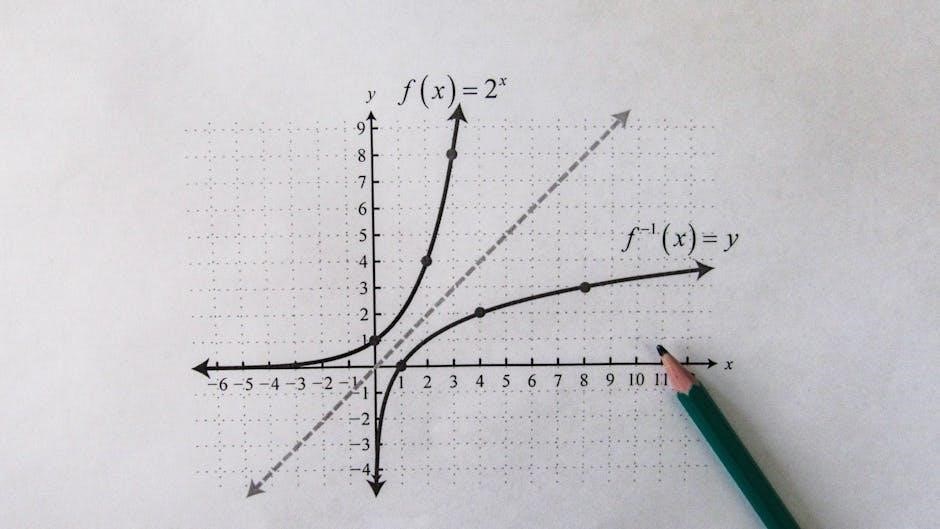
Exponential Function: y = aˣ
The exponential function, y = aˣ, where ‘a’ is a constant greater than zero and not equal to one, represents exponential growth or decay. Parent function charts, often available as PDF resources, illustrate its key properties. When a > 1, the function exhibits exponential growth, rapidly increasing as x increases. Conversely, when 0 < a < 1, it demonstrates exponential decay, decreasing towards zero;
These charts highlight a horizontal asymptote at y = 0, as the function never actually reaches zero. The domain is all real numbers, while the range is all positive real numbers. PDF guides emphasize the function’s importance in modeling real-world phenomena like population growth and radioactive decay.

Using a Parent Functions Chart for Transformations
Parent function charts, often in PDF format, visually demonstrate how shifts, stretches, and reflections alter graphs, aiding comprehension of function transformations.
Understanding Function Transformations
Function transformations involve altering a parent function’s graph through shifts, stretches, and reflections, creating a family of related functions. A parent functions chart, frequently available as a PDF resource, is invaluable for visualizing these changes.

Vertical and horizontal shifts adjust the graph’s position, while vertical stretches or compressions modify its shape. Reflections across the x or y-axis invert the graph. Understanding these transformations is key to analyzing and manipulating functions effectively.
These changes are often represented algebraically by adding or multiplying constants within the function’s equation. A well-organized chart clarifies how each alteration impacts the graph, domain, and range, solidifying comprehension for students and professionals alike.
How the Chart Aids in Identifying Transformations
A parent functions chart, often found as a convenient PDF, streamlines the process of recognizing function transformations. By comparing a given function’s graph to its parent function, students can quickly pinpoint shifts, stretches, and reflections.
The chart visually demonstrates how alterations to the equation—like adding a constant—translate to specific graphical changes. For example, a “+k” indicates a vertical shift.
This comparative analysis builds a strong intuitive understanding of transformation rules. Furthermore, the chart reinforces the connection between algebraic representation and graphical behavior, accelerating problem-solving skills and fostering a deeper grasp of function properties.
Resources for Downloadable Parent Functions Charts (PDF)
Numerous online resources offer free parent functions charts in PDF format. Websites dedicated to mathematics education frequently provide these charts as study aids for students.
Many high school and college mathematics departments also post downloadable versions on their websites, supporting classroom learning. A quick web search for “parent functions chart PDF” yields a wealth of options, ranging from basic charts to more comprehensive guides.
These PDFs often include graphs, domains, ranges, and key features, making them invaluable tools for mastering fundamental function concepts and preparing for assessments.
Leave a Reply
You must be logged in to post a comment.